
Glossary of Catholic Terms
(St Paul’s R.C. Church, Alnwick)
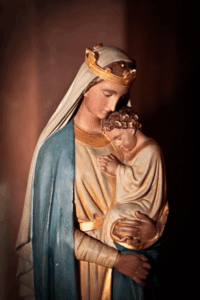
“Seek and Ye Shall find…” (Matthew 7-7)
Absolution: The act by which a priest, acting as the minister of Christ, grants forgiveness of sins in the Sacrament of Reconciliation (Confession).
Acolyte: One who assists the priest or deacon during liturgical celebrations (e.g. carrying candles, holding the bishop’s mitre or crozier, etc.).
Adoration: The external act of reverent worship and homage offered to God alone.
Adoration of the Blessed Sacrament: Prayer and worship directed to Christ truly present in the Holy Eucharist, exposed for veneration by the faithful.
Altar: The table upon which the Sacrifice of the Mass is offered. It is the central focus of the church during the celebration of the Eucharist. Also called The Table of the Lord.
Ambo: The lectern or stand from which the Scriptures are proclaimed during Mass.
Amen: A Hebrew word meaning “truly” or “so be it.” Used to express assent to prayer and acceptance of God’s will.
Annulment: Officially termed a decree of nullity, this is a declaration by Church authorities that a marriage was invalid from the beginning.
Apostle / Apostolic: From the Greek apostolos, meaning “one who is sent.” Refers to the Twelve whom Jesus chose to spread His teaching. Apostolic denotes connection to their mission or the authority of the Holy See.
Apostolate: Any work or ministry undertaken for the service of God, the Church, and humanity.
Apostolic Nunciature: The office of the Holy Father’s diplomatic representative (the Apostolic Nuncio) in a particular country.
Apse: A domed or vaulted semicircular recess at the east end of a church, often behind the altar.
Archbishop: A bishop who presides over an ecclesiastical province, having limited authority over the dioceses within it.
Archdiocese: The chief diocese within a province, governed by an archbishop.
Aspergillum: A liturgical instrument used for sprinkling holy water, usually a metal rod with a perforated bulb at the end.
Auxiliary Bishop: A bishop appointed to assist the diocesan bishop in pastoral and administrative duties.
Baldacchino: A canopy erected over an altar or carried in processions above an object of veneration.
Basilica: A church granted special privileges by the Pope because of its antiquity, dignity, or historical importance.
Beatification: The final step before canonisation; the Pope declares that a deceased person lived a holy life and may be venerated as “Blessed.”
Bishop: The chief pastor of a diocese, responsible for the spiritual care of the faithful and the administration of the sacraments within his jurisdiction.
Blessed Sacrament: The consecrated Eucharist—Christ’s Body and Blood—whether during Mass or reserved in the tabernacle.
Breaking of the Bread: The action at Mass that recalls Christ’s gesture at the Last Supper, symbolising unity in the one Bread of Life.
Brother: A man who is a member of a religious order but not ordained as a priest.
Canon: From the Greek for “rule” or “measure.” Refers to the official list of inspired books of Scripture, or to laws governing the Church (Canon Law).
Canon Law: The codified body of laws governing the Church’s organisation, discipline, and administration.
Canonisation: The formal declaration by the Pope that a person is a saint and worthy of universal veneration.
Cantor: The person who leads the congregation in singing during the liturgy.
Cardinal: A senior churchman appointed by the Pope to assist in governing the Church and elect future Popes.
Cassock: A long, close-fitting robe worn by clergy; black for priests, purple for bishops, red for cardinals, and white for the Pope.
Catechesis: Religious instruction and formation in the faith, particularly for those preparing for baptism (catechumens) or continuing faith formation.
Catechetical / Catechetics: Pertaining to the teaching of faith; the systematic instruction of believers.
Cathedral: The principal church of a diocese, containing the bishop’s chair (cathedra).
Catholic: From the Greek meaning “universal.” The term was first used for the Church in a letter by St Ignatius of Antioch (c. AD 107).
Celebrant: The priest or bishop who presides over the Eucharist.
Chalice: The cup used to hold the wine that becomes the Blood of Christ.
Chancellor: The priest or layperson responsible for official records and documents in a diocese.
Charisms: Spiritual gifts or graces bestowed by the Holy Spirit for the good of the Church.
Chasuble: The outermost vestment worn by a priest or bishop when celebrating Mass.
Christ: From the Greek Christos, meaning “the Anointed One”; the title of Jesus as Messiah.
Church: The People of God—those baptised into Christ—existing as the universal Church, local dioceses, and individual parishes.
Ciborium: A covered vessel used to hold the consecrated hosts for distribution during Holy Communion.
Clergy: Those who have received Holy Orders (bishops, priests, and deacons).
Cloister: The enclosed area of a convent or monastery reserved for members of the religious community.
College of Cardinals: The body of cardinals who assist the Pope and elect his successor.
Collegiality: The shared responsibility of all bishops, in communion with the Pope, for the governance of the Church.
Compline: The Church’s official night prayer, part of the Divine Office.
Confession: The act of acknowledging one’s sins in the Sacrament of Reconciliation.
Confirmation: The Sacrament of Initiation which strengthens the grace of Baptism through the anointing of the Holy Spirit.
Contemplative: A religious man or woman dedicated to a life of prayer, silence, and seclusion.
Convent: A house or community of women religious.
Cross / Crucifix: A cross becomes a crucifix when it bears the image of Christ.
Council of Priests: The consultative body of priests who advise the bishop in governing the diocese.
Deacon / Diaconate: The first rank of Holy Orders. Deacons serve in liturgy, word, and charity, either as transitional (preparing for priesthood) or permanent.
Dean / Vicar Forane: A priest appointed by the bishop to oversee several parishes within a deanery.
Diocese: A community of the faithful under the pastoral care of a bishop.
Dispensation: A relaxation of a particular law granted by Church authority.
Ecclesiastical: Relating to the organisation or government of the Church.
Ecumenism: The movement seeking unity among Christians, and dialogue with members of other faiths.
Encyclical: A pastoral letter from the Pope addressed to the whole Church.
Episcopal: Pertaining to bishops or their authority.
Eschatology: The theological study of the last things—death, judgement, heaven, and hell.
Eucharistic Prayer: The central prayer of thanksgiving and consecration during the Mass.
Evangelist: One of the four Gospel writers—Matthew, Mark, Luke, and John—or one who preaches the Gospel.
Excommunication: The most severe ecclesiastical penalty, excluding a baptised person from participation in the Church’s sacramental life.
Grace: The free and unmerited gift of God’s divine life, necessary for salvation.
Holy Communion: The reception of the Body and Blood of Christ in the Eucharist.
Holy See: The jurisdiction of the Pope as Bishop of Rome and head of the universal Church; also refers to the Vatican’s governing offices.
Homily: A reflection by the priest or deacon on the Scripture readings, applying them to daily Christian life.
Host (Sacred Host): The consecrated bread which has become the Body of Christ.
Immaculate Conception: The doctrine that the Blessed Virgin Mary was preserved from original sin from the moment of her conception.
Incense: Fragrant material burned during liturgical worship, symbolising prayers rising to God.
Indulgence: The remission of temporal punishment due for sins whose guilt has already been forgiven.
INRI: The Latin inscription placed above Christ’s cross: Iesus Nazarenus Rex Iudaeorum — “Jesus of Nazareth, King of the Jews.”
Keys, Power of the: The authority given by Christ to St Peter and his successors to govern and absolve within the Church.
Laity: Baptised members of the Church who are neither ordained clergy nor members of religious orders.
Lauds: The Church’s official morning prayer, part of the Divine Office.
Lectionary: The book containing Scripture readings used in the liturgy.
Liturgical Colours: Specific colours of vestments denoting seasons and feasts: green (Ordinary Time), purple (Advent/Lent), white (Christmas/Easter and feasts), red (martyrs, Pentecost).
Liturgy: The official public worship of the Church, especially the celebration of the Sacraments and the Divine Office.
Mary: The Blessed Virgin Mary, Mother of God and the foremost of all the saints, honoured in special feasts and devotions such as the Rosary.
Mass: The central act of Catholic worship, the Eucharistic Sacrifice instituted by Christ at the Last Supper.
Matins: The Church’s official daily prayer, part of the Divine Office.
Matrimony: The Sacrament by which a baptised man and woman are united in lifelong covenantal love.
Monastery / Monk / Nun: A community of men (monks) or women (nuns) who live under religious vows, devoted to prayer and service.
None: The Church’s official afternoon prayer, part of the Divine Office.
The Order of Mass: is the fixed structure and sequence of prayers, readings, and rites that make up the celebration of the Holy Eucharist.
Ordination: The conferral of the Sacrament of Holy Orders, making a man a deacon, priest, or bishop.
Parish: A local community of the faithful within a diocese, under the pastoral care of a parish priest.
Parish Priest: The priest entrusted with the pastoral care of a parish and its faithful.
Paten: A small plate used to hold the Eucharistic bread.
Pectoral Cross: A cross worn on a chain by bishops and abbots as a sign of their office.
Prayer: The raising of the mind and heart to God, expressed in adoration, thanksgiving, repentance, and petition.
Purgatory: The state of purification after death for souls destined for heaven but still in need of cleansing from sin.
Rosary: A meditative prayer recalling events in the lives of Jesus and Mary, recited with the aid of a string of beads.
Sanctuary: The area of the church where the altar stands, reserved for the clergy and ministers during liturgy.
Scripture: The inspired Word of God contained in the Old and New Testaments.
Sext: The Church’s official midday prayer, part of the Divine Office.
Sign of the Cross: The gesture of tracing a cross upon oneself while invoking the Holy Trinity.
Tabernacle: The secure, often ornate, receptacle in which the Blessed Sacrament is reserved.
Terce: The Church’s official mid-morning prayer, part of the Divine Office.
Trinity (Holy): The central mystery of Christian faith—one God in three Persons: Father, Son, and Holy Spirit.
Vatican: The residence of the Pope and administrative centre of the Catholic Church in Vatican City, Rome.
Veneration: The act of showing reverence and honour to saints and sacred objects, distinct from the worship (latria) due to God alone.
Vespers: The Church’s official evening prayer, part of the Divine Office.
Vow: A solemn promise made to God, typically within religious life, to live in poverty, chastity, and obedience.
Zucchetto: The skullcap worn by the Pope (white), cardinals (red), and bishops (purple).