
The History of St Paul’s RC Church, Alnwick
A Victorian landmark reborn as a living Catholic parish in the heart of Alnwick.
Origins and Architectural Beginnings
The building that now serves as St Paul’s Roman Catholic Church was erected in the mid-nineteenth century (1845–46) to a design by the noted architect Anthony Salvin, working for the 3rd Duke of Northumberland. Conceived in the Gothic Revival style and built in dressed stone with slate roofs, it was intended to serve a growing residential district on the western side of town and originally opened for Anglican worship.
Local tradition in Alnwick often remarks that the church was “built without foundations”. While the story endures, surviving nineteenth-century practice and national listing records indicate construction consistent with the norms of the day. Either way, the church’s robust fabric and distinctive tower have made it a familiar landmark for generations.
From Anglican to Catholic
Following redundancy as an Anglican church in the late twentieth century, the building entered a new chapter. In 1982 it was acquired and rededicated for Catholic worship within the Diocese of Hexham and Newcastle. This translation of use brought together a faithful Catholic community with a historic Victorian church, uniting past and present in a single place of prayer.
At the time of conversion, devotional items and fittings from the former Catholic church in Bailiffgate were incorporated, ensuring continuity of parish memory and sacramental life in the town.
Stained Glass and Interior Treasures
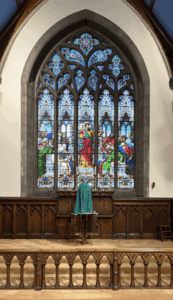
St Paul’s is graced by notable stained glass, most famously the east window associated with the artist William Dyce, depicting St Paul and St Barnabas preaching at Antioch. The window forms a luminous catechesis in coloured light, drawing the eye to the altar and anchoring the whole interior in the mission of the Apostle to the Gentiles.
The church also preserves characteristic Victorian Gothic furnishings: carved timber work, traceried details, and a coherent liturgical arrangement that complements its soaring volume. Together these elements lend the interior a harmony well suited to Catholic worship and quiet prayer.
Parish Life and Community Today
Since its Catholic dedication, St Paul’s has flourished as a welcoming parish for Alnwick and the surrounding area. The church is a centre for Sunday Mass, weekday liturgy, the sacraments, and parish initiatives in prayer, catechesis, and outreach. Its location close to the town centre makes it a natural gathering-place, while its history gives it a distinctive identity within the wider Northumbrian Catholic story.
Legacy and Significance
The journey of St Paul’s from a nineteenth century Anglican foundation to a vibrant Catholic parish speaks of continuity through change. It is a house of God that carries the memory of the town, the craftsmanship of the Victorian era, and the living faith of today’s community. Its windows preach the Gospel in colour; its stones hold the prayers of generations; its doors remain open in welcome to all who seek Christ.
For further reading on the building’s Victorian origins, stained glass, and listing details, consult diocesan resources and national heritage registers.
Glória in excélsis Deo.