Our Life of Faith
Walk with us at St Paul’s, in a rediscovery of our life of faith. The Catholic faith is the living tradition of God’s revelation in Jesus Christ, a faith that is both ancient and ever new. It is the response of the human heart to the God who made us, who saves us, and who calls us to share His life forever.
In the words of the Catechism (CCC 1): “God, infinitely perfect and blessed in Himself, in a plan of sheer goodness freely created man to make him share in His own blessed life.” Everything the Church believes flows from that truth: God is love, and all creation exists to share in His divine love.
Rooted in the Gospel, Strengthened by the Sacraments, Guided by the Spirit
1. Who Is God?
(CCC 198–231; 268–278)
Catholics believe in one God, eternal, almighty, and all-loving, the Creator of heaven and earth. He is not distant or abstract, but personal and near to us. We know Him not because human reason discovered Him, but because He chose to reveal Himself. He made His covenant with Israel, spoke through the prophets, and revealed His face completely in His Son, Jesus Christ.
“The Lord is merciful and gracious, slow to anger and abounding in steadfast love.” (Psalm 103:8)
Analogy:
Imagine sunlight. We do not see the sun directly, yet we see its light and feel its warmth. In the same way, though we cannot see God, His presence illuminates our lives and gives warmth to our souls.
To know God, then, is not to understand Him fully, for the finite cannot contain the infinite, but to enter a loving relationship with Him through faith, prayer, and the life of the Church.
2. The Holy Trinity — One God in Three Persons
(CCC 232 – 267)
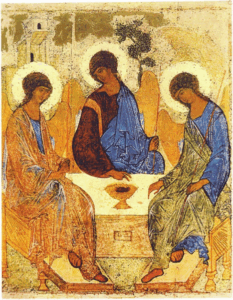
The Trinity is the central mystery of Christian faith and life: there is one God in three Divine Persons, the Father, the Son, and the Holy Spirit. They are not three gods, but one divine nature shared by three distinct Persons, each fully and equally God.
This truth is beyond reason, yet not contrary to it. It is the revelation of who God truly is, a communion of love. The Father loves the Son; the Son loves the Father; and their love is the Holy Spirit, love itself, living and personal.
“The Father is God, the Son is God, the Holy Spirit is God, yet there are not three Gods, but one God.” (Athanasian Creed)
Analogies (imperfect, but hopefully helpful):
- The Flame Analogy: A single flame has light, heat, and fire, each distinct, yet all one flame. So too, in God there is unity of being with distinct relations: Father (the source), Son (the Word and light), and Spirit (the warmth of divine love).
- The Mind Analogy (St Augustine example): The human mind can remember, understand, and will, three faculties within one soul. Likewise, in God there is one divine being expressed through three persons.
- The Water Analogy (used cautiously): Water can exist as ice, liquid, or vapour, three forms, yet one substance. This shows how one nature may be experienced in different ways, though it must be remembered that the Persons of the Trinity coexist eternally and are not “forms” of God but distinct relations of one essence.
The Trinity reminds us that relationship and love lie at the heart of all existence, and that every act of creation and redemption flows from the love shared within the divine life.
3. Creation and Humanity
(CCC 279 – 421)
God created the world freely out of love, not out of need. All that exists bears the mark of His wisdom and goodness. Human beings, made in His image and likeness, are unique, capable of knowing God, loving Him, and freely choosing the good through moral direction.
Sin entered the world through human disobedience, breaking our harmony with God, ourselves, and creation. Yet God’s plan of love never failed, He sent His Son to restore what was lost.
“O happy fault that earned for us so great, so glorious a Redeemer!” (Easter Exsultet)
4. Jesus Christ, the Son of God and Saviour
(CCC 422 – 682)
Jesus Christ is the eternal Word of God who became man for our salvation “Et Verbum caro factum est, et habitávit in nobis.” “The Word became flesh and dwelt among us.” (John 1:14). Born of the Virgin Mary by the power of the Holy Spirit, He lived among us, suffered, died, and rose again so that we might share His divine life.
He is both fully God and fully man, the one Mediator between God and humanity. By His Cross, Christ conquered sin; by His Resurrection, He conquered death.
Through His Ascension (CCC 659 – 667), Christ entered the glory of heaven, where He reigns at the right hand of the Father. His humanity, now glorified, is forever united to God, a sign of our eternal destiny.
Analogy for the Ascension:
Think of a diver emerging from the depths, carrying with him a pearl from the ocean floor. In His Ascension, Christ, who descended into our human condition, returns to the Father bearing the redeemed humanity of us all, showing that our home is not the grave but heaven.
The Ascension is not Christ’s departure but His exaltation; He is now present everywhere through the Spirit, interceding for us and preparing a place for us, His faithful.
5. The Holy Spirit
(CCC 683 – 747)
The Holy Spirit is the third Person of the Trinity, the Love of God poured into our hearts (Romans 5:5). He is the breath of God, the sanctifier of souls, the soul of the mother Church.
It is through the Holy Spirit that we come to believe, to love, to pray, and to act with divine strength. The Spirit gives gifts of wisdom, understanding, counsel, fortitude, knowledge, piety, and holy fear (Isaiah 11:2–3), forming Christ within us.
Analogy:
Just as the wind is invisible but its presence is known by the movement of the leaves, so the Holy Spirit is unseen but His work is evident, in faith awakened, hearts changed, and lives renewed.
6. The Blessed Virgin Mary and the Assumption
(CCC 96 3– 975; 966)
Mary, the Mother of God, is honoured as the first and greatest disciple. Conceived without sin, she accepted God’s will with perfect faith, saying, “Let it be done to me according to your word.” (Luke 1:38)
At the end of her earthly life, Mary was assumed body and soul into heavenly glory. The Assumption (CCC 966) is not the same as Christ’s Ascension, for He ascended by His own divine power, while she was taken up by God’s grace.
Analogy:
If Christ is the Sun, Mary is the Moon, she shines not with her own light, but with the reflected glory of her Son. The Assumption shows us what God intends for all who love Him: the full sharing of His life, body and soul, in eternity.
Mary’s Assumption is the pledge of our own resurrection and a sign of hope for the Church on earth.
7. The Church
(CCC 748–975)
The Church is the Body of Christ, both visible and spiritual. Founded by Jesus upon the Apostles, "you are Peter, and on this rock I will build my church"(Matthew 16:18) it is one, holy, catholic, and apostolic. Through the Church, Christ continues His saving work, administering grace through the Word and the Sacraments.
To belong to the Church is to live in communion with God, with one another, and with the saints who have gone before us. “For where two or three are gathered in my name, there am I among them.” (Matthew 18:20)
8. The Sacraments
(CCC 1113 – 1134)
The sacraments are visible signs of God’s invisible grace, instituted by Christ to sanctify us. They accompany us through life: we are born anew in Baptism, strengthened in Confirmation, nourished in the Eucharist, forgiven in Reconciliation, healed in the Anointing of the Sick, called in Holy Orders, and united in Matrimony.
Each sacrament is a personal encounter with Christ, drawing us into His divine and eternal life.
9. The Moral Life and the Commandments
(CCC 1691 – 2557)
To follow Christ is to live in truth and love. The moral teaching of the Church shows how faith becomes action, how love of God is expressed through love of neighbour.
The Commandments and the Beatitudes together illuminate the path of true discipleship,
a way of life shaped by mercy, justice, humility, and love. The Church is called to shape the culture in which it lives, not to be shaped by passing cultural trends, so that the light of the Gospel remains constant in every age.
Read The Beatitudes and Commandments
10. Prayer and Worship
(CCC 2558 – 2865)
Prayer is the voice of faith. It is the lifting of our hearts and mind to God in trust and love. The Church’s highest prayer is the Holy Mass, in which Christ’s sacrifice is made present and His Body and Blood are given for our salvation.
“The Eucharist is the source and summit of the Christian life.” (CCC 1324)
The Church also treasures devotions such as the Holy Rosary, the Angelus, and Adoration of the Blessed Sacrament. All leading us deeper into the mystery of God’s love.
The Lord’s Prayer is the complete prayer. It contains every petition we need to bring before God and expresses the foundations of Christian faith and trust. It also provides the ideal framework for forming our own personal prayers, guiding us to speak to God with love and humility.
A Collection of Essential Catholic Prayers
11. Life Everlasting
(CCC 1020 – 1065)
We believe in “the resurrection of the body and life everlasting.” At death, the soul meets God in particular judgment, and at the end of time all will rise again to share in the final judgment of Christ.
Heaven is the eternal communion of life and love with the Holy Trinity, the angels, and the saints. Purgatory is the merciful purification of souls destined for heaven. Hell is the tragic state of those who freely reject God’s love.
“I am the resurrection and the life; whoever believes in Me, though he die, yet shall he live.” (John 11:25)
The Catholic faith is not merely a system of belief but a living relationship with God the Father, The Son, and Holy Spirit, who calls us to holiness and eternal life through repentance, forgivness and love. It is lived through prayer, the sacraments, acts of charity, and daily fidelity to the Gospel.
As the Catechism concludes:
“May the grace of the Lord Jesus be with all. Amen.” (CCC 1065)
How it all relates to us at St Paul’s
At St Paul’s, this is what we try to live out every day. We believe that faith isn’t just ideas or rules — it’s a relationship. It’s learning to trust that God is close to us, guiding us, healing us, and walking with us through every season of life. We discover this through prayer, through receiving the sacraments, and through supporting one another as a parish family.
In simple terms:
You matter. Your life has purpose. You were made for love. And your journey with God has a home here.